Seasonal Rental Turnover Cleanouts on Cape Cod
Why the Cape's seasonal-rental and second-home turnover runs on its own clock — end-of-season cleanouts, storm backlog, and what Massachusetts bans from a dumpster.
ReadPlacement Guide
A practical guide to protecting your driveway during dumpster delivery in Wareham, covering concrete, asphalt and gravel surfaces, freeze-thaw winters, narrow streets and when a right-of-way permit applies.
A dumpster delivery in Wareham sets a loaded steel container down on the same driveway you park a car on every day — but where it lands, and what's underneath it, matters more here than in a place that never sees a real New England winter. Between freeze-thaw cycles, gravel drives common on the outskirts of Plymouth County, and narrow older streets close to downtown, a few minutes of planning before delivery day goes a long way toward protecting your surface and avoiding a placement problem you only notice after the container is gone.
Wareham sits on Buzzards Bay, so its weather is coastal — hurricanes and tropical systems in late summer and fall, nor'easters in winter. That much snow, and the repeated freeze-thaw cycling that comes with a Wareham-area winter and early spring, already puts driveways and pavement under stress before a dumpster ever shows up — asphalt or concrete that has cracked or heaved from winter frost is more vulnerable to further damage from a stationary, heavy container sitting in one spot. A loaded roll-off concentrates its weight on a narrow set of steel rails rather than spreading it out the way a parked car does, so a surface that already took a beating from the season needs a little more care.
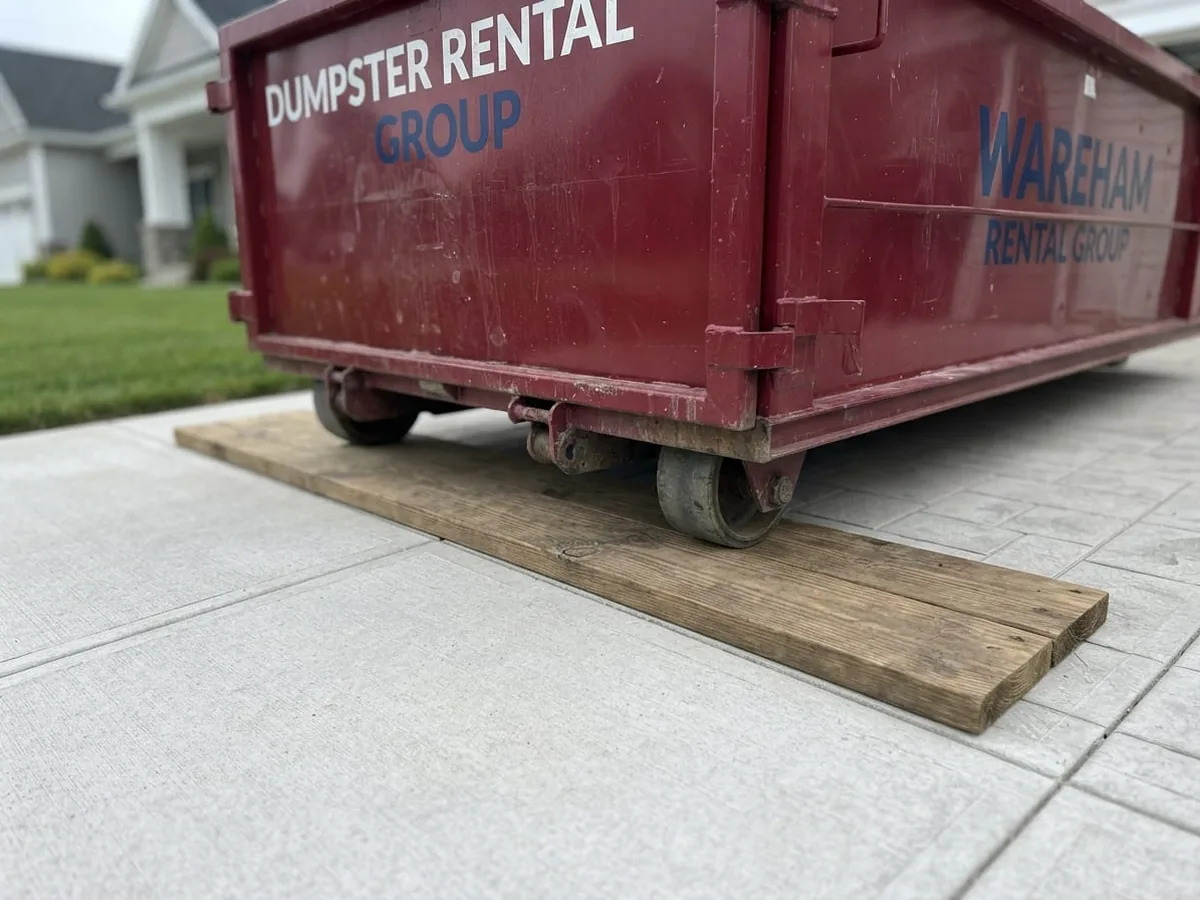
The standard protective step, on concrete or asphalt alike, is setting wood boards or sheets of plywood under the container's delivery rails before it's set down. That spreads the load across a wider area of the surface instead of concentrating it on a narrow line, which matters most on a driveway with any existing cracking, a decorative finish, or a slab that's still relatively new. Asphalt is also temperature sensitive — it softens slightly on a warm day and becomes more prone to indentation, and after a hard winter it can also be more brittle where frost has worked into existing cracks. Either way, mentioning your surface and its condition when you book gives the driver a chance to bring the right protection and set the container in the spot that will hold up best.
Gravel and dirt driveways are common in the more rural stretches of our service area — parts of Point Independence, Plymouth and Rochester in particular see less paved frontage than in-town Wareham. Gravel generally handles a container's point-load weight better than pavement does, since loose material shifts and settles instead of cracking. The thing to watch for is soft or loosely compacted ground, especially right after spring thaw when frost is still coming out of the ground and everything underfoot is softer than usual — a container set down on a soft spot can settle unevenly, which affects how the doors swing and how level the load sits. Pointing out any soft or low spots before delivery lets the driver choose the firmest, most level section of the drive.
Some of Wareham's older residential streets were laid out well before anyone was thinking about roll-off delivery trucks, and on-street parking can narrow the effective width even further in winter, when snowbanks push in from both sides. If your street is tight, has regular on-street parking, or is a dead end with limited turnaround room, it helps to mention that when you schedule delivery so the driver can plan the approach and backing path ahead of time, rather than working it out from behind the wheel.
A dumpster that stays entirely on your own private driveway typically doesn't require any city permit. Placing one on a public street, sidewalk, or other public right-of-way inside Wareham is a different matter — the Town of Wareham requires a fire-district permit (any container six cubic yards or larger) from the fire district that covers the address, plus a town obstruction permit for the public way. If your driveway is too short, too narrow, or already full, and street placement is the only realistic option, plan on that permit step before delivery day. For the surrounding towns we serve — Marion, Mattapoisett, Bourne, Rochester, Plymouth and the rest — permit rules are set town by town rather than through a county office; Plymouth County still has a county government, but it does not issue permits; a quick call to your town's Select Board office or DPW confirms what applies before you book.
Before delivery day, walk your own driveway or street frontage and take stock of a few things: the surface type — concrete, asphalt, gravel or dirt — and its condition, whether frost heave or winter cracking left any weak spots, whether your street is tight enough that the driver should plan around it, and whether street placement, and a permit, is even in play. Passing that along when you book is the simplest way to make sure the container lands in the right spot, on the right protection, with no surprises for you or the driver.
Talk to a real person
Call (774) 355-5829 and describe the job. Flat price, stated tonnage allowance, and a delivery window on the same call.
Mon–Sat 7:00am – 7:00pm
From this guide
It's a good idea, especially on concrete that's newer or has a decorative finish, and on asphalt or concrete that took a beating from winter frost heave. Boards or plywood under the delivery rails spread the container's weight across a wider area and reduce the chance of surface marking.
Generally yes, since gravel handles point-load weight better than pavement. The main thing to watch for is uneven settling if the ground is soft or loosely compacted, which is more common right after spring thaw, so pointing that out before delivery helps the driver pick the most stable section.
Yes, if the container will sit on a public street, sidewalk or right-of-way rather than entirely on your own driveway. the Town of Wareham requires a fire-district permit for any container larger than six cubic yards, from the fire district that covers the address, plus a town obstruction permit if it sits in the public way. A dumpster kept fully on a private driveway typically does not need one.
Each of the neighboring towns we serve sets its own permit rules through its own Select Board office or Department of Public Works; Plymouth County still has a county government, but dumpster permits are a town and fire-district matter. A quick call to your town's office before booking confirms what, if anything, applies.
Let us know when you schedule delivery. Mentioning on-street parking, snowbanks, low trees, or a tight cul-de-sac in advance gives the driver a chance to plan the truck's approach and backing path ahead of time instead of working it out in the moment.
Keep reading
Why the Cape's seasonal-rental and second-home turnover runs on its own clock — end-of-season cleanouts, storm backlog, and what Massachusetts bans from a dumpster.
ReadFrom Onset Bay and Onset Beach to the Victorian cottages, the bandstand and the pier, a look at Wareham's historic summer-resort village — and what its tight, seasonal streets mean for a dumpster delivery.
ReadA breakdown of the real factors behind dumpster rental pricing in Wareham, MA — size, tonnage, rental duration, distance, and material type — with no invented price figures.
Read